FR
EN
Case study
The YBA.ai team · October 2026

Filling a pipeline takes two levers: reaching enough prospects, and understanding each one well enough to give them a reason to reply.
Personalization is nothing new: it has been on the table for years. Yet the tools on the market personalize the first name, the last name, sometimes the company. Not the prospect’s reality: what they are measured on, what keeps them up at night, what they aim to achieve.
As a result, most teams bet on volume and neglect the second lever. We did too. Here is how we changed our approach.
We did what everyone does
When we launched YBA.ai, we adopted the best-known tools on the market: multichannel campaigns on email and LinkedIn, sequences, scenarios, meeting booking.
We built our lists, wrote our sequences, launched our campaigns. We assumed the meetings would follow.
Result: zero meetings.
An agency, and a first lesson
So we invested: a lead gen agency took over our campaigns, with a marketing campaign tool and five-email sequences per contact.
On email, results stayed close to zero: one meeting for nearly 5,000 contacts.
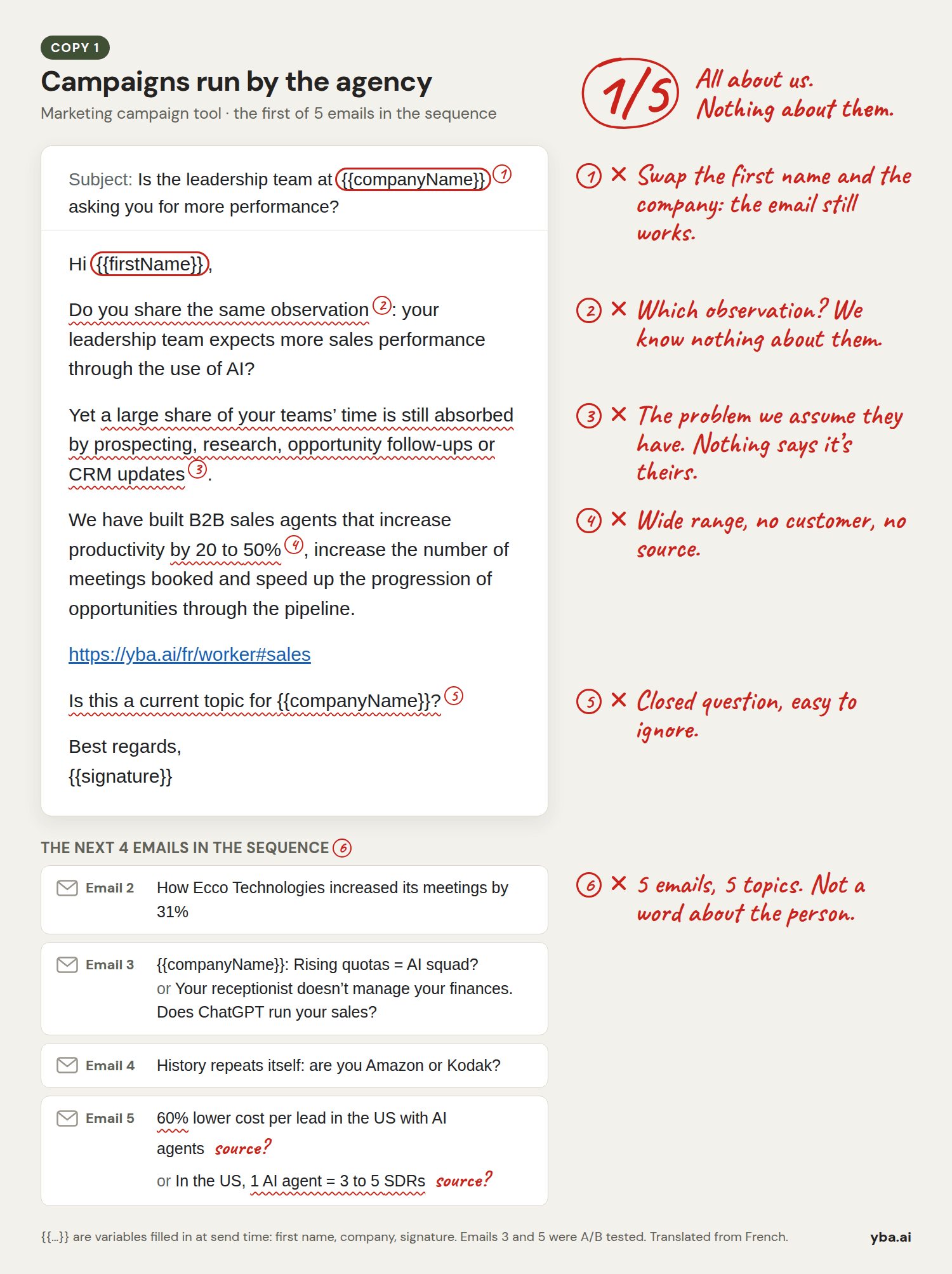
Cold calling, on the other hand, delivered far better results.
The difference comes down to one thing: on the phone, there is a conversation. You listen, you bounce back, you talk about what matters to the other person.
Hence our first lesson.
It is not email volume that fills a pipeline. It is the relevance of the conversation.
The challenge was to bring into an email what makes the phone work.
Our first Pipeline Agent
So we built our first Pipeline Agent, with one goal: take everything that comes before sending off the rep’s plate.
The rep enters a company name. The agent handles the rest:
it loads our preferences: the profiles to target, our value proposition;
it identifies 10 to 40 relevant contacts depending on account size, with their email, phone and career history;
it searches for available news on the company, the prospect and their role;
it draws on our document base to personalize the offer;
it writes the email and logs everything in the CRM.
For the team, the gain is immediate: the three hours of preparation for an account’s first contact are now handled by the agent. And meetings grow by 30%.
The news trap
Rereading the emails, however, we found a limit. Meetings were coming in, but relevance was uneven: some messages hit the mark, others missed.
A real example. The agent writes to the sales director of a store belonging to a major retail chain. It relies on solid news: the chain announces a shift to omnichannel and hundreds of store openings by 2030. It infers pressure on the pipeline, the CRM and follow-ups, and pitches our follow-up agent, with customer proof.
The email is clean: the news is accurate, the proof is quantified. But this news concerns the group, not its recipient. Her reality is her store, her customers, her revenue. Not a B2B pipeline to chase.
The agent saw the news. It did not connect it to the person’s reality.
Go one step further. Take ten sales directors in ten companies: same title, ten realities. One is working on cost to serve, another is opening a new market, a third must make the forecast reliable, a fourth must shorten the sales cycle. A message built on the job title or on company news is likely to miss what matters.
That is where it all plays out.

Deep Reality: understand before you write
So we rethought the product with a dual ambition: generate our own leads and build a real competitive advantage. The result is called Deep Reality: a capability we have not seen at any other player on the market, and which we now deploy across all our agents.
Deep Reality reproduces human reasoning. Facing a prospect, a good rep cross-checks dozens of pieces of information to understand who they are talking to. The agent cross-checks hundreds, and infers the person’s deep reality: their stakes, what keeps them up at night, what they aim to accomplish.
Where the first version stopped at company news, Deep Reality looks at the person’s day-to-day: their market, how they sell, the nature of their business, their customers, their teams. By cross-checking all of this, it identifies exactly where we can help.
The email we would never have written
The most striking part: at the start, the agent does not know what it will write. Neither do we. There is no script, only a reality to understand, from which the message follows.
Some emails surprise us. We first wonder why the agent wrote that, then we understand.
An example, transposed to preserve anonymity. The agent writes to the CMO of a logistics software company. It picked up two facts: the company is about to launch its own AI product to create new opportunities, and a colleague of the CMO, Tom, leads US revenue.
Taken separately, these are two pieces of news. The agent connects them: if AI generates signals and Tom owns US revenue, the challenge is to turn those signals into opportunities that are actually followed up. That is exactly what our agents do. It closes by offering an ROI estimate, with Tom if that makes sense.
The agent names the colleague. It understood who does what, where the stakes lie, and it opens the door to the right person.
We had never thought of that. The agent wrote it on its own.

The results
We rolled out Deep Reality in our Pipeline Agent. In the first month, we got 48 times more meetings than with our campaigns. In the second month, 72 times more.

The ×14 measures the effect of the message alone: per 1,000 contacts, the agent gets 3 meetings, versus 0.21 with our campaigns. With a single email per contact, where our sequences sent five.
The rest is a scale effect: for the same number of emails, one email instead of five reaches five times more contacts. 14 × 5 = 70: that is the ×72.
For the prospect, the difference is clear: one email that is about them, instead of five that only talk about us.
Two new markets
In the second month, we also opened the United Arab Emirates and the United States.
With our campaigns, each country needed its own version of the message, translated and adapted. With the agent, there is no version to translate: each email is written for its recipient, in their language, with the right tone for their country.
An example in the UAE, at an e-commerce company: first email on September 22, an internal referral from its CEO, a reply from the head of advertising the next day, a discovery meeting on September 29.
Follow-ups that bring a new angle
The first email is only the beginning. If there is no reply, another of our agents takes over. It does not follow up for the sake of it: it finds a new angle on its own, a new reason to reply.
Result: 10 to 20% more meetings, on top of the ×14, which only counts the first email.
Sales reps who smile again
Then there is the impact on the team. We hired a sales rep who became a Revenue Architect. She is thriving in the role.
She focuses on value-added work and leaves the rest to the agents: the Pipeline Agent prepares and writes the prospecting, the Sales Execution Agent moves deals forward between meetings. Result: ×2.1 productivity.
No more thankless tasks: reps spend their time on the most interesting part of their job. Revenue goes up, cost to serve goes down.
Our agency, a refocused role
We are continuing our partnership with our lead gen agency, but we work differently. We handle the whole phase, from contact collection to digital engagement. The agency focuses on cold calling, with far more concrete pitches: for each prospect, the agent prepares the brief and logs it in the CRM.
First results next month. Stay tuned.
Challenges with pipe gen, sales velocity, revenue or cost to serve?
Let’s talk: yba@yba.ai
The YBA.ai team
Note: to protect our prospects’ confidentiality, we replaced the names of companies and people with fictitious names, or blurred them. Emails translated from French.