DEPLOY AI WORKERS IN PROD IN DAYS
DEPLOY AI WORKERS IN PROD IN DAYS
Deploy context-aware AI Workers to execute complex processes end-to-end, collaborating seamlessly with your human teams. An enterprise-grade agentic platform integrated into your IT ecosystem within days.
Deploy context-aware AI Workers to execute complex processes end-to-end, collaborating seamlessly with your human teams. An enterprise-grade agentic platform integrated into your IT ecosystem within days.

New RFP from Airbus. 42 questions · Due in 5 days
.png)
Replace references with luxury sector case studies — they’re watching this closely.
✓ Got it. Re-running with LVMH, Hermès & Kering refs…
Done Boss !
New RFP from Airbus. 42 questions · Due in 5 days
Replace references with luxury sector case studies — they’re watching this closely.
✓ Got it. Re-running with LVMH, Hermès & Kering refs…
Done Boss !




01
Build Deterministic, In-Context Agents
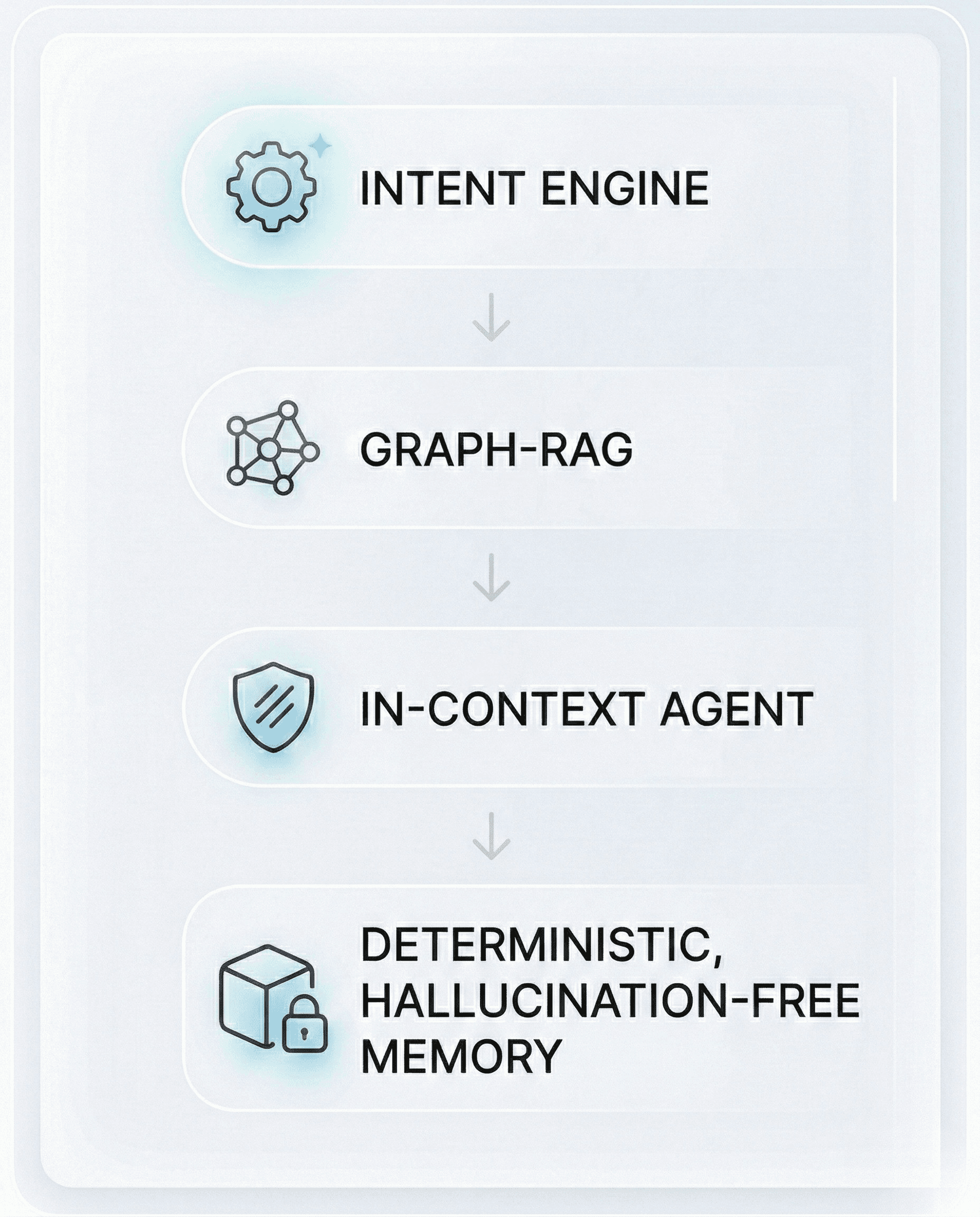
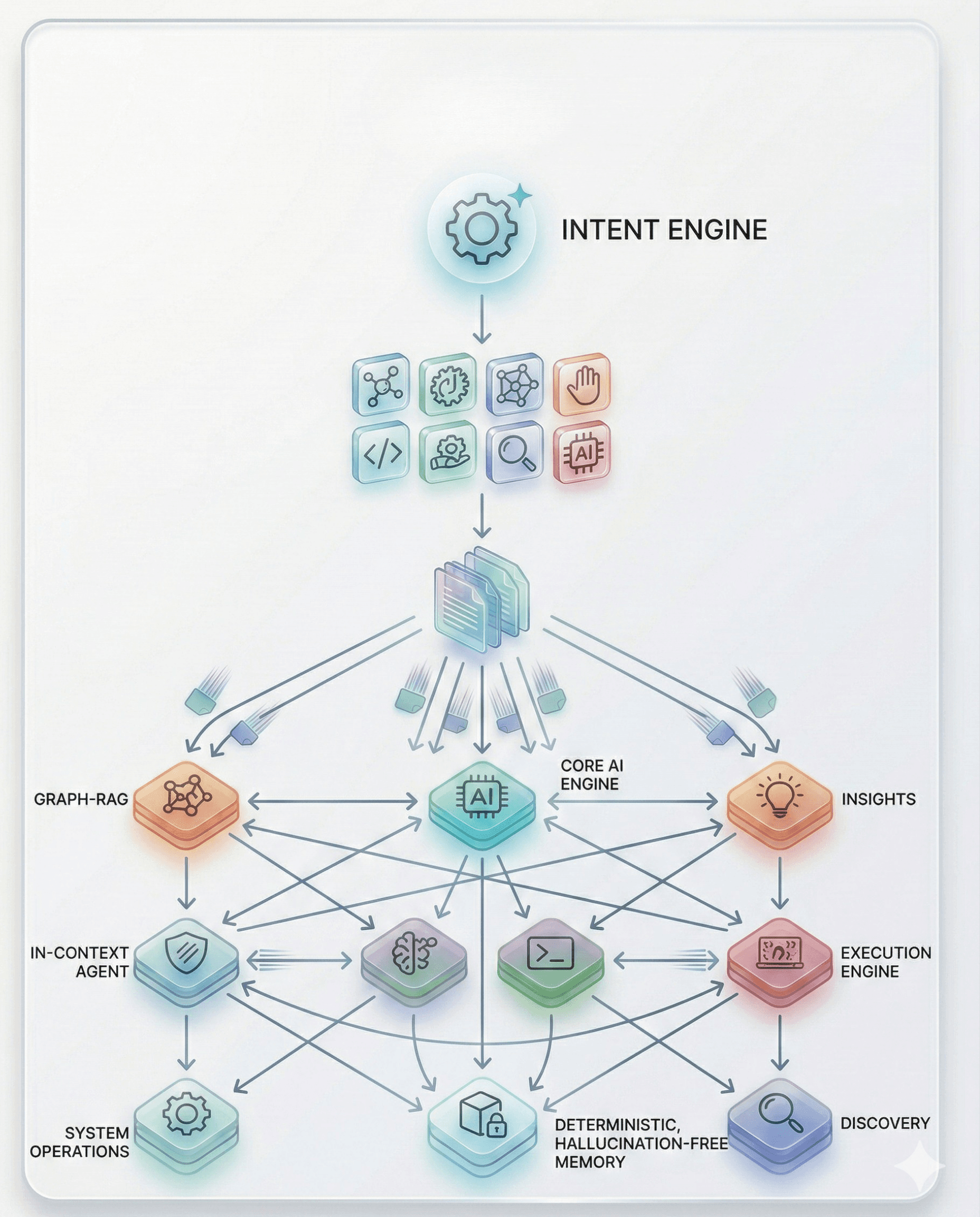
We replace basic RAG with a multi-stage cognitive architecture. An upstream engine evaluates intent, Graph-RAG retrieves relational data, and a final In-Context Agent filters out the noise.

02
Don't just assign tasks. Delegate outcomes
Forget brittle, "If/then" Agents. Our dynamic planner breaks down complex goals by orchestrating a swarm of specialized sub-agents. It evaluates the context, decides the best execution path on the fly, and autonomously sequences API calls without ever relying on fixed workflows.
03
Self-Healing & Cognitive Reflection
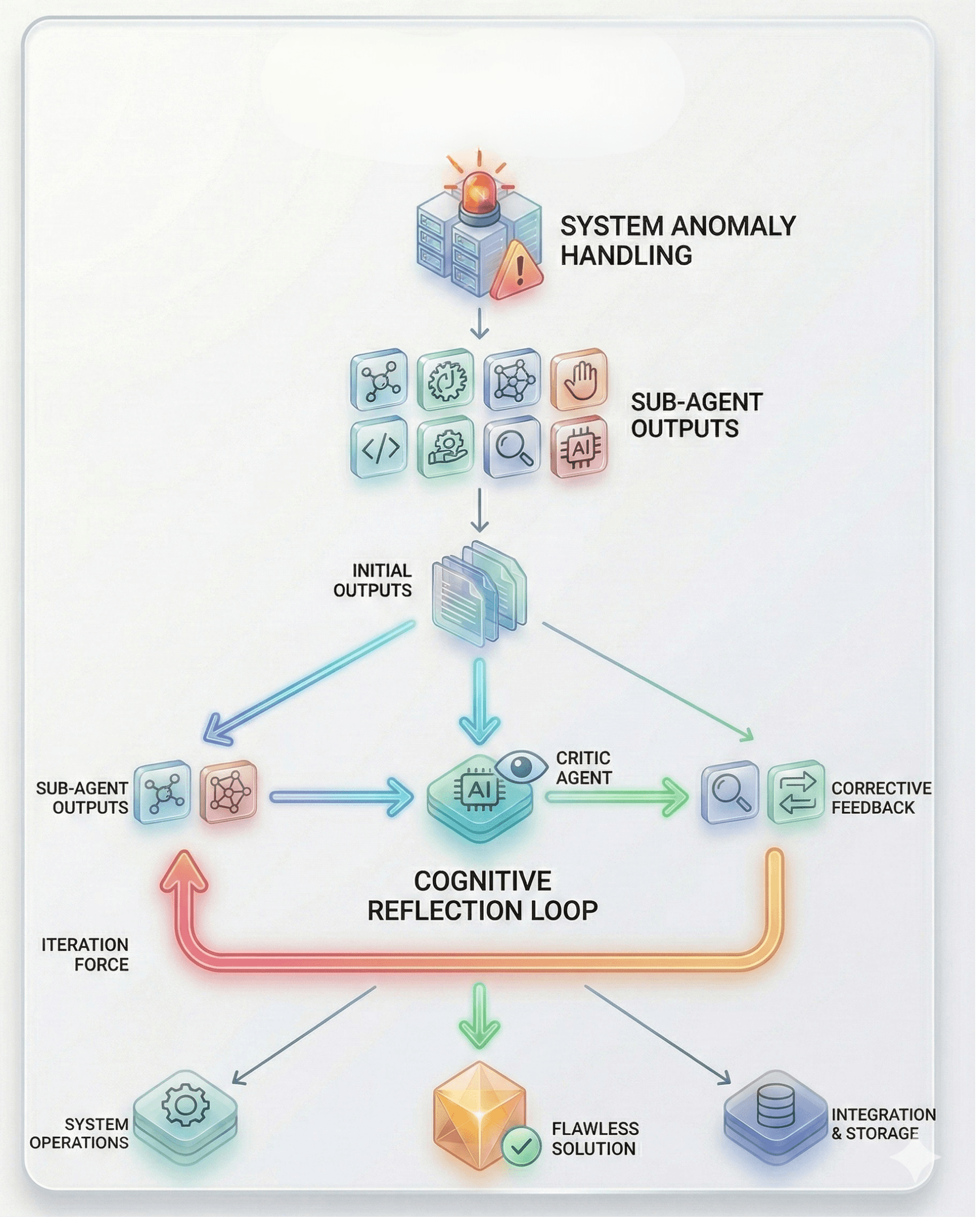
Production environments demand absolute precision. Alongside handling system anomalies, we deploy a cognitive reflection loop. An autonomous Critic Agent assesses sub-agent outputs, provides corrective feedback, and forces iterations until the generated solution flawlessly hits your predefined goals.
01
Build Deterministic, In-Context Agents
We replace basic RAG with a multi-stage cognitive architecture. An upstream engine evaluates intent, Graph-RAG retrieves relational data, and a final In-Context Agent filters out the noise.
02
Don't just assign tasks. Delegate outcomes
Forget brittle, "If/then" Agents. Our dynamic planner breaks down complex goals by orchestrating a swarm of specialized sub-agents. It evaluates the context, decides the best execution path on the fly, and autonomously sequences API calls without ever relying on fixed workflows.
03
Self-Healing & Cognitive Reflection
Production environments demand absolute precision. Alongside handling system anomalies, we deploy a cognitive reflection loop. An autonomous Critic Agent assesses sub-agent outputs, provides corrective feedback, and forces iterations until the generated solution flawlessly hits your predefined goals.
01
Build Deterministic, In-Context Agents
We replace basic RAG with a multi-stage cognitive architecture. An upstream engine evaluates intent, Graph-RAG retrieves relational data, and a final In-Context Agent filters out the noise.
02
Don't just assign tasks. Delegate outcomes
Forget brittle, "If/then" Agents. Our dynamic planner breaks down complex goals by orchestrating a swarm of specialized sub-agents. It evaluates the context, decides the best execution path on the fly, and autonomously sequences API calls without ever relying on fixed workflows.
03
Self-Healing & Cognitive Reflection
Production environments demand absolute precision. Alongside handling system anomalies, we deploy a cognitive reflection loop. An autonomous Critic Agent assesses sub-agent outputs, provides corrective feedback, and forces iterations until the generated solution flawlessly hits your predefined goals.
The Enterprise-Grade Agentic Operating System
Centralize, secure, and scale your autonomous workforce with a unified cognitive infrastructure designed for Enterprise IT
LLM Agnostic

Deploy in Days
Omnichannel connectivity

Security & Compliance

LLM Agnostic
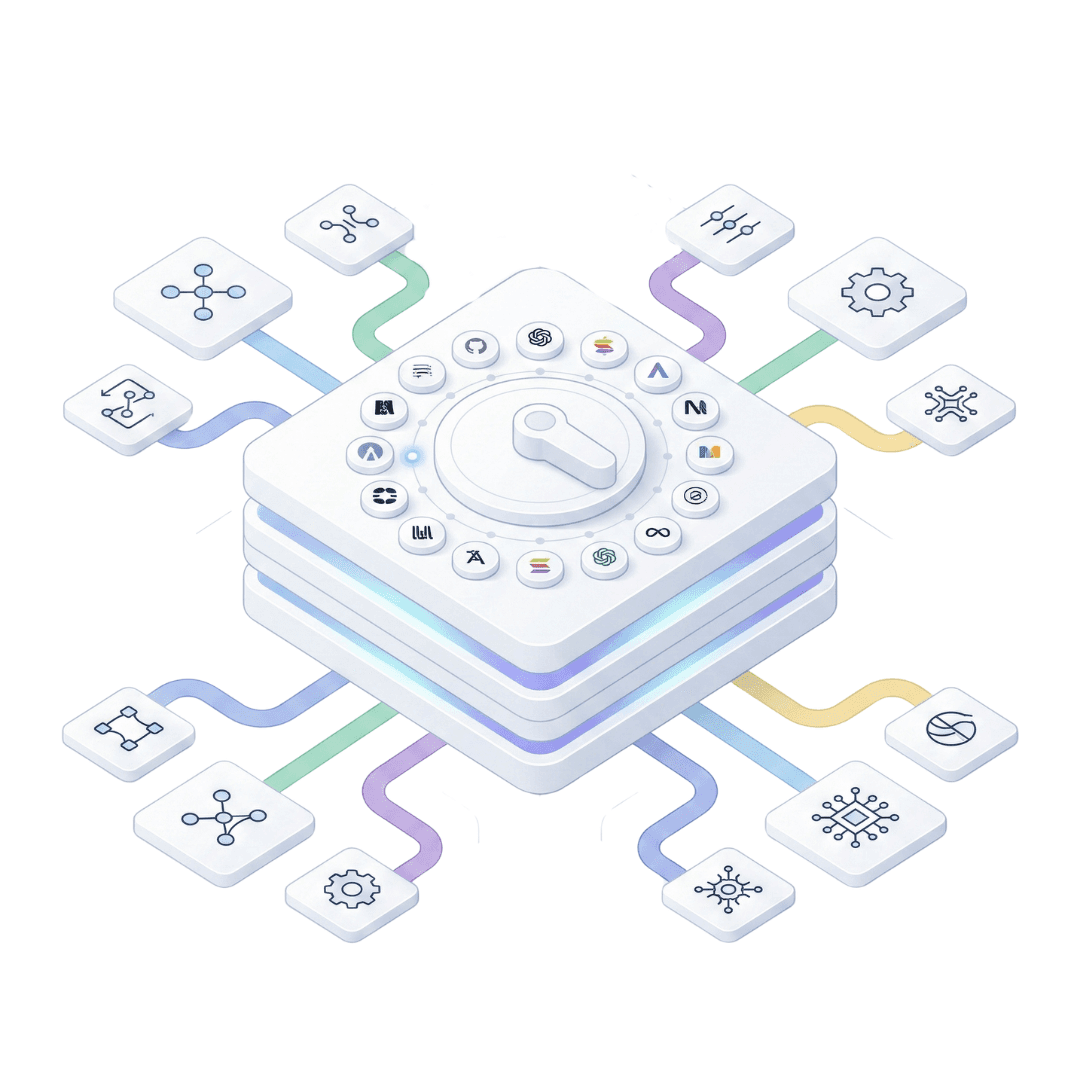
Don't let your infrastructure limit your intelligence. Switch LLM models in minutes to leverage the newest innovations from OpenAI, Anthropic, or emerging open-source leaders. YBA ensures your business logic remains intact while your "brain" evolves
LLM Agnostic
Deploy in Days
Omnichannel connectivity
Security & Compliance
LLM Agnostic
Don't let your infrastructure limit your intelligence. Switch LLM models in minutes to leverage the newest innovations from OpenAI, Anthropic, or emerging open-source leaders. YBA ensures your business logic remains intact while your "brain" evolves
100+ Powerful Plug-and-Play Integrations
Connect agents to your favorite tools to perform actions and keep your teams in sync.
100+ Powerful Plug-and-Play Integrations
Connect agents to your favorite tools to perform actions and keep your teams in sync.
01
Explore 100+ natively supported integrations. Connect to your entire tech stack in seconds with pre-built connectors.
02
Full CRUD capabilities: Create, Read, Update, and Delete. Your agents don't just "watch" data—they manage it across all your platforms.
03
Securely link and automate your cross-platform workflows. Deploy enterprise-grade security while automating complex multi-app tasks.




" Pipeline generation, RFP responses, quotes: YBA does in ten minutes what used to take my team days — so they can finally focus on client relationships and closing ".
Fabrizio Rindone
CEO, Ecco-Technologies
" In luxury, client relationships run on hyper-personalization. With YBA’s agents, our teams stay fully focused on clients, and the company scales with incredible productivity: +42% sales productivity. "
Akram El Fadil
Partner & Co-founder, Reetain
" 91% of our procurement tasks automated, stockouts anticipated, shortages under control. YBA’s agents have transformed our day-to-day. "
Clément Véranda
CEO, Pharmafit

Consumption-based model
Credit YBA



4.9/5 Rated
Agentic Platform + AI Worker Catalog
High-Performance LLM: Fast, accurate, and reliable AI.
Persistent Memory: Contextual history and archiving.
Plug & Play: Instant pre-built app connectors.
Team Governance: Secure role-based access control.
Data Security: Full end-to-end encryption.
Consumption-based model
Simple, transparent pricing with no hidden fees.
Credit YBA
Agentic Platform + AI Worker Catalog
High-Performance LLM: Fast, accurate, and reliable AI.
Persistent Memory: Contextual history and archiving.
Plug & Play: Instant pre-built app connectors.
Team Governance: Secure role-based access control.
Data Security: Full end-to-end encryption.
4.9/5 Rated
Consumption-based model
Simple, transparent pricing with no hidden fees.
Credit YBA
Agentic Platform + AI Worker Catalog
High-Performance LLM: Fast, accurate, and reliable AI.
Persistent Memory: Contextual history and archiving.
Plug & Play: Instant pre-built app connectors.
Team Governance: Secure role-based access control.
Data Security: Full end-to-end encryption.
4.9/5 Rated
Your questions, answered
Get quick answers to the most common questions about our platform and services.
Your questions, answered
Get quick answers to the most common questions about our platform and services.
Where is my data hosted, and can I choose the region?
Your data is hosted on enterprise-grade cloud infrastructure with full region selection. For example, you can choose EU-only residency to meet local regulatory requirements, including GDPR. All data is encrypted end-to-end with AES-256, and strict tenant isolation ensures your information is never shared across environments. Your data is never used to train any underlying AI model — zero training policy, no exceptions.
Who builds and configures the agents — your team or mine?
Both — you choose. For complex, business-critical processes, our team designs, configures, and deploys your agents end-to-end: from mapping your workflow to connecting your tools through our 100+ pre-built connectors. No technical expertise required. But YBA is also a self-service platform. Your teams can create, adapt, and extend their own agents directly from the interface — always within the guardrails you define: role-based permissions, approved connectors and data scopes, spending limits, and mandatory validation checkpoints. Admins keep full visibility and control over every agent created, so autonomy never comes at the cost of governance.
What types of business processes can your agents automate?
Any structured or semi-structured process where a human repeatedly works with data and systems — across every department, not just sales and procurement. Live use cases include RFP response automation, prospecting and pipeline orchestration, supplier sourcing and order management, restocking and PO generation, compliance questionnaires, document processing, and CRM data hygiene. Each AI Worker is built around a specific use case with its own measurable ROI. And because our architecture supports multi-agent orchestration, processes can span departments and tools: a Sourcing Agent can hand off to a Compliance Agent, which triggers a PO — end-to-end, without human glue in between.
How much autonomy do the agents have? How does Human-in-the-Loop work?
You decide, per agent and per step. Three levels: Full autonomy — the agent executes the entire process end-to-end and reports the result. Human-in-the-Loop (HITL) — the agent runs its workflow (analysis, drafting, data retrieval) but pauses at the checkpoints you define: before sending an email, submitting an order, or updating a system of record. Your team approves, requests changes, or overrides — from the YBA interface, Webchat, Teams/Slack, or API. Human-on-the-Loop — the agent acts autonomously, but every action is logged in a full audit trail, and you can intervene or roll back at any time.
What's the difference between an AI Worker and a chatbot or RPA bot?
A chatbot answers questions. An RPA bot replays a fixed script and breaks the moment anything changes. An AI Worker is different: it's given an outcome ("respond to this RFP", "restock this warehouse") and autonomously plans the steps, navigates your tools, retrieves the right data, executes, and self-corrects when something unexpected happens. It's goal-driven, context-aware, and resilient — closer to delegating to a colleague than programming a macro.
What is a Knowledge Graph, and why do you use one instead of basic RAG?
Basic RAG retrieves documents that "look similar" to a question — which works for simple lookups but fails on business logic, where facts are connected. A Knowledge Graph structures your enterprise data as entities and relationships: this product belongs to this range, complies with this regulation, is priced under this contract, was sold to this client. Our Graph-RAG engine navigates these relationships instead of guessing from text similarity. The result: answers grounded in verified, connected facts
What is multi-hop reasoning?
It's the ability to answer questions that require chaining several pieces of information that live in different places. Example: "Which of our suppliers for eco-friendly packaging are compliant with the new EU regulation and can deliver within 3 weeks?" No single document contains that answer. The agent has to hop: suppliers → their certifications → the regulation's requirements → current lead times. Single-hop RAG can't do this reliably; our Knowledge Graph architecture is built for it. It's what separates answering trivia from executing real business processes.
How does agent memory work?
YBA agents have layered, persistent memory: Working memory — the live context of the current task (the RFP being answered, the order being processed). Long-term memory — everything the agent has learned about your business: past interactions, decisions, corrections, preferences. When your team corrects an agent once ("always use luxury-sector references for this client"), it remembers. Shared organizational memory — the Knowledge Graph itself, updated continuously, so every agent in your workforce works from the same single source of truth.
What is the AI Worker catalog?
A library of pre-built, production-ready agents for the most common enterprise processes — Pipeline Agent, Deal Progress Agent, RFP Agent, Sourcing Agent, Restock Agent, Compliance Agent, CRM Agent, and more. Each comes with its workflow, integrations, and guardrails pre-configured, so it deploys in days, not months. Catalogue agents are a starting point, not a constraint: every one is customized to your data, rules, and tools — and custom agents can be built for processes unique to your business.
Which LLMs do you use? Am I locked into one model?
None in particular — that's the point. YBA is LLM-agnostic: your agents can run on models from OpenAI, Anthropic, Mistral, or leading open-source alternatives, and you can switch in minutes. Your business logic, memory, and integrations live in the YBA layer, not in the model — so when a better or cheaper model ships, your "brain" upgrades without rebuilding anything. For EU-sensitive workloads, models can be served from EU-hosted endpoints.
How do you prevent hallucinations and errors in production?
Three layers. First, deterministic grounding: agents only act on verified data from your Knowledge Graph — not on what a model "thinks" is true. Second, cognitive reflection: an autonomous Critic Agent reviews every output against your predefined standards, sends corrective feedback, and forces iterations until quality targets are met — before anything reaches your team. Third, self-healing execution: if an API fails or data is missing, the agent detects it, adapts its plan, and retries rather than silently producing garbage. Add HITL checkpoints on sensitive actions, and you get production-grade reliability — not demo-grade.
How do agents connect to my existing tools?
Through 100+ pre-built, plug-and-play connectors: CRM (Salesforce, HubSpot…), ERP and procurement (SAP, Ariba…), collaboration (Teams, Slack, Outlook, Gmail…), document stores (SharePoint, Drive…), and more. Connectors support full CRUD — agents don't just read your data, they act on it. For internal or legacy systems, our team builds custom connectors via API. All connections use OAuth or scoped service accounts with least-privilege access, and every action is logged.
How does pricing work?
Simple: one model, credit-based. You purchase credits, and your agents consume them as they work. And credits cover everything — there's no stacking of fees: LLM usage (whichever models your agents run on) Agentic execution and orchestration The platform itself: interface, monitoring, governance, admin RAG and Knowledge Graph infrastructure All connectors and integrations
How long does it take to deploy an AI Worker?
Catalogue agents connected to standard tools typically go live in days. Custom agents on complex, multi-system processes take 2 to 4 weeks, including workflow mapping, integration, and a validation phase in HITL mode with your team. You don't need to mobilize your IT department: our team handles the setup, and connectors are non-intrusive — no rip-and-replace of your existing stack.
What happens after deployment? What support do I get?
Every plan includes the platform monitoring interface — real-time visibility on each agent's activity, executions, and performance — plus standard support covering platform issues and bugs, and regular platform updates. For teams that want more, we offer premium support services: proactive follow-up and performance reviews of your agents, upgrades and optimization of existing agents as your processes evolve, and creation of new agents by our team. You choose the level of accompaniment that fits your organization — from fully self-managed to fully managed by YBA.
Where is my data hosted, and can I choose the region?
Your data is hosted on enterprise-grade cloud infrastructure with full region selection. For example, you can choose EU-only residency to meet local regulatory requirements, including GDPR. All data is encrypted end-to-end with AES-256, and strict tenant isolation ensures your information is never shared across environments. Your data is never used to train any underlying AI model — zero training policy, no exceptions.
Who builds and configures the agents — your team or mine?
Both — you choose. For complex, business-critical processes, our team designs, configures, and deploys your agents end-to-end: from mapping your workflow to connecting your tools through our 100+ pre-built connectors. No technical expertise required. But YBA is also a self-service platform. Your teams can create, adapt, and extend their own agents directly from the interface — always within the guardrails you define: role-based permissions, approved connectors and data scopes, spending limits, and mandatory validation checkpoints. Admins keep full visibility and control over every agent created, so autonomy never comes at the cost of governance.
What types of business processes can your agents automate?
Any structured or semi-structured process where a human repeatedly works with data and systems — across every department, not just sales and procurement. Live use cases include RFP response automation, prospecting and pipeline orchestration, supplier sourcing and order management, restocking and PO generation, compliance questionnaires, document processing, and CRM data hygiene. Each AI Worker is built around a specific use case with its own measurable ROI. And because our architecture supports multi-agent orchestration, processes can span departments and tools: a Sourcing Agent can hand off to a Compliance Agent, which triggers a PO — end-to-end, without human glue in between.
How much autonomy do the agents have? How does Human-in-the-Loop work?
You decide, per agent and per step. Three levels: Full autonomy — the agent executes the entire process end-to-end and reports the result. Human-in-the-Loop (HITL) — the agent runs its workflow (analysis, drafting, data retrieval) but pauses at the checkpoints you define: before sending an email, submitting an order, or updating a system of record. Your team approves, requests changes, or overrides — from the YBA interface, Webchat, Teams/Slack, or API. Human-on-the-Loop — the agent acts autonomously, but every action is logged in a full audit trail, and you can intervene or roll back at any time.
What's the difference between an AI Worker and a chatbot or RPA bot?
A chatbot answers questions. An RPA bot replays a fixed script and breaks the moment anything changes. An AI Worker is different: it's given an outcome ("respond to this RFP", "restock this warehouse") and autonomously plans the steps, navigates your tools, retrieves the right data, executes, and self-corrects when something unexpected happens. It's goal-driven, context-aware, and resilient — closer to delegating to a colleague than programming a macro.
What is a Knowledge Graph, and why do you use one instead of basic RAG?
Basic RAG retrieves documents that "look similar" to a question — which works for simple lookups but fails on business logic, where facts are connected. A Knowledge Graph structures your enterprise data as entities and relationships: this product belongs to this range, complies with this regulation, is priced under this contract, was sold to this client. Our Graph-RAG engine navigates these relationships instead of guessing from text similarity. The result: answers grounded in verified, connected facts
What is multi-hop reasoning?
It's the ability to answer questions that require chaining several pieces of information that live in different places. Example: "Which of our suppliers for eco-friendly packaging are compliant with the new EU regulation and can deliver within 3 weeks?" No single document contains that answer. The agent has to hop: suppliers → their certifications → the regulation's requirements → current lead times. Single-hop RAG can't do this reliably; our Knowledge Graph architecture is built for it. It's what separates answering trivia from executing real business processes.
How does agent memory work?
YBA agents have layered, persistent memory: Working memory — the live context of the current task (the RFP being answered, the order being processed). Long-term memory — everything the agent has learned about your business: past interactions, decisions, corrections, preferences. When your team corrects an agent once ("always use luxury-sector references for this client"), it remembers. Shared organizational memory — the Knowledge Graph itself, updated continuously, so every agent in your workforce works from the same single source of truth.
What is the AI Worker catalog?
A library of pre-built, production-ready agents for the most common enterprise processes — Pipeline Agent, Deal Progress Agent, RFP Agent, Sourcing Agent, Restock Agent, Compliance Agent, CRM Agent, and more. Each comes with its workflow, integrations, and guardrails pre-configured, so it deploys in days, not months. Catalogue agents are a starting point, not a constraint: every one is customized to your data, rules, and tools — and custom agents can be built for processes unique to your business.
Which LLMs do you use? Am I locked into one model?
None in particular — that's the point. YBA is LLM-agnostic: your agents can run on models from OpenAI, Anthropic, Mistral, or leading open-source alternatives, and you can switch in minutes. Your business logic, memory, and integrations live in the YBA layer, not in the model — so when a better or cheaper model ships, your "brain" upgrades without rebuilding anything. For EU-sensitive workloads, models can be served from EU-hosted endpoints.
How do you prevent hallucinations and errors in production?
Three layers. First, deterministic grounding: agents only act on verified data from your Knowledge Graph — not on what a model "thinks" is true. Second, cognitive reflection: an autonomous Critic Agent reviews every output against your predefined standards, sends corrective feedback, and forces iterations until quality targets are met — before anything reaches your team. Third, self-healing execution: if an API fails or data is missing, the agent detects it, adapts its plan, and retries rather than silently producing garbage. Add HITL checkpoints on sensitive actions, and you get production-grade reliability — not demo-grade.
How do agents connect to my existing tools?
Through 100+ pre-built, plug-and-play connectors: CRM (Salesforce, HubSpot…), ERP and procurement (SAP, Ariba…), collaboration (Teams, Slack, Outlook, Gmail…), document stores (SharePoint, Drive…), and more. Connectors support full CRUD — agents don't just read your data, they act on it. For internal or legacy systems, our team builds custom connectors via API. All connections use OAuth or scoped service accounts with least-privilege access, and every action is logged.
How does pricing work?
Simple: one model, credit-based. You purchase credits, and your agents consume them as they work. And credits cover everything — there's no stacking of fees: LLM usage (whichever models your agents run on) Agentic execution and orchestration The platform itself: interface, monitoring, governance, admin RAG and Knowledge Graph infrastructure All connectors and integrations
How long does it take to deploy an AI Worker?
Catalogue agents connected to standard tools typically go live in days. Custom agents on complex, multi-system processes take 2 to 4 weeks, including workflow mapping, integration, and a validation phase in HITL mode with your team. You don't need to mobilize your IT department: our team handles the setup, and connectors are non-intrusive — no rip-and-replace of your existing stack.
What happens after deployment? What support do I get?
Every plan includes the platform monitoring interface — real-time visibility on each agent's activity, executions, and performance — plus standard support covering platform issues and bugs, and regular platform updates. For teams that want more, we offer premium support services: proactive follow-up and performance reviews of your agents, upgrades and optimization of existing agents as your processes evolve, and creation of new agents by our team. You choose the level of accompaniment that fits your organization — from fully self-managed to fully managed by YBA.

Start your journey
Let’s start building something great together.
Start your journey
Let’s start building something great together.
4.9 / 5 Rated
Start your journey
Let’s start building something great together.
4.9 / 5 Rated